On your B2B sourcing journey across Alibaba.com, Made‑in‑China and Global Sources, you will quickly run into one of the most persistent debates: should you work with a direct manufacturer or a trading company?
Many new Western importers absorb a simple rule: “always choose the factory”. This is a dangerous oversimplification. Some of the smoothest, lowest‑risk trial orders are placed with competent trading companies, while some direct factories lack export experience, English support or compliance knowledge required for US, EU and UK markets.
The label “Factory” shown on a B2B profile is also unreliable. Thousands of trading firms market themselves as manufacturers to win inquiries. This guide is built specifically for Amazon, Shopify and brick‑and‑mortar importers. We break down how each supplier model operates, compare their strengths and weaknesses, share practical tests you can run to expose fake factory profiles, and give clear scenarios where each type is the better fit.
Recall our earlier disclaimer: no supplier type removes your legal responsibility as the importer of record. You remain accountable for classification, certification, labelling and customs declarations regardless of whether you buy from a factory or a trader.
What Is a Manufacturer?
A manufacturer owns its production facility, machinery, production staff and workflow. It physically makes the goods you order in‑house. Factories tend to specialise in a narrow product range aligned with their equipment, such as silicone household goods, injection‑moulded plastic parts, textile garments or metal hardware.
✅ Key Advantages of Working with a Manufacturer
- Better unit pricing at scale: No middleman markup. For large, repeat bulk orders, the per‑piece cost advantage is meaningful.
- Full control over customisation and tooling: Manufacturers can build new moulds, adjust material formulations, modify dimensions, colours and finishes for your OEM / private‑label design. They hold direct control over samples and production tweaks.
- Deep technical expertise: Their engineering and production teams understand tolerances, material grades, defect modes and production constraints. They can troubleshoot quality issues at the source.
- Direct IP alignment: When you sign IP and mould‑ownership clauses, you contract directly with the party producing your goods. This reduces the risk of your custom design being shared with competing buyers.
- Stable long‑term production roadmap: If your product becomes a steady seller, a reliable factory can scale output and lock in capacity for your seasonal spikes.
❌ Main Drawbacks of Manufacturers
- Higher MOQs: Factories are structured around production runs. Setup time and tooling costs make small trial orders uneconomical for them.
- Limited product range: A factory specialises in one production process. It cannot easily supply unrelated categories like electronics plus wooden decor plus pet toys.
- Uneven export readiness: Many small domestic factories have limited English skills, weak familiarity with CE, FCC, CPSIA, UKCA or California Prop 65 requirements, and limited experience preparing commercial documents for Western customs.
- Less flexible support: They are production‑focused, not customer‑service focused. Response times may slow during peak production periods, and they may not consolidate multiple shipments for you.
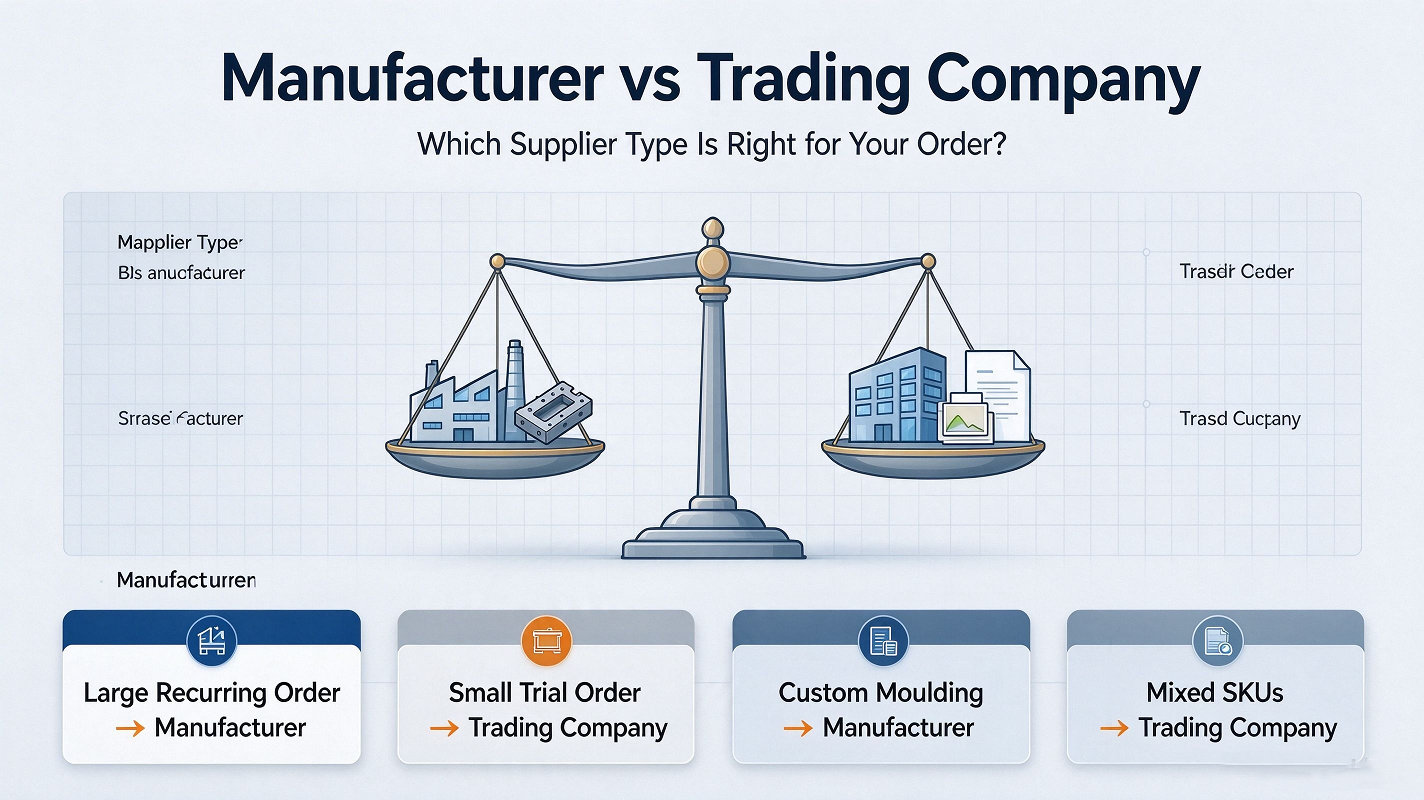
🎯 Best for: Large recurring orders, custom moulding / tooling, proprietary private‑label designs, products requiring tight material and process control, buyers with established QC workflows.
What Is a Trading Company?
A trading company does not manufacture goods. It acts as an intermediary: it sources finished or semi‑finished products from multiple independent factories, consolidates them, handles sales communication, paperwork and export coordination, and resells to you for a margin.
✅ Key Advantages of Working with a Trading Company
- Flexible, lower MOQs: Traders combine orders from many buyers across different factories. They can often accept small trial quantities that standalone factories will refuse.
- Broader product portfolio: One trusted trading partner can supply multiple unrelated SKUs from different manufacturers, saving you the work of managing 5–10 separate factory relationships.
- Strong export and compliance experience: Good trading companies hire dedicated English‑speaking sales teams and routinely prepare commercial invoices, packing lists, test reports and shipping documents for US, EU and UK buyers. They understand your market’s certification and labelling requirements.
- Better project management for beginners: They coordinate sampling, consolidate cargo, handle communications and translate your requirements to the underlying factory. This reduces miscommunication risk for first‑time importers.
- Faster sampling for standard items: Since they maintain relationships with a network of producers, they can often source ready samples quickly from their partner factories.
❌ Main Drawbacks of Trading Companies
- Built‑in margin: They add 5%–15% markup over the factory price. On large orders, this difference can significantly compress your profit margin.
- One layer removed from production: Quality issues require the trader to relay feedback to the factory. This can slow corrective action and create confusion around root causes.
- IP risk: The trading company controls which factory makes your goods. If contracts are loose, the underlying factory may produce the same design for other buyers.
- Variable transparency: Some traders will hide the name and location of their manufacturing partners, preventing you from running direct factory audits.
🎯 Best for: First‑time importers, small test orders, mixed‑SKU shipments, standard off‑the‑shelf products, buyers without Chinese‑speaking support, and sellers who value convenience over rock‑bottom unit price.
Manufacturer vs Trading Company Comparison Table
| Factor | Manufacturer | Trading Company |
|---|---|---|
| Ownership | Owns production lines and equipment | Sources goods from external factories |
| Unit price | Lower for large volume | Higher, includes intermediary markup |
| Typical MOQ | Higher | Lower and flexible |
| Custom OEM / ODM | Excellent, can build custom moulds | Limited, depends on partner factories |
| Product range | Narrow, specialised category | Wide, multi‑category sourcing |
| English & export paperwork | Variable; many small factories lack experience | Usually strong, built for overseas B2B |
| Quality control | Direct control over production | Indirect, coordinates with factories |
| IP & mould control | Direct contractual relationship | Extra clauses required to protect IP |
| Ideal buyer profile | High‑volume, custom design, seasoned importer | New importer, small trial order, mixed SKUs |
How to Verify if a B2B Supplier Is a Real Factory (Practical Tests You Can Run)
B2B marketplace badges such as “Factory” or “Verified Manufacturer” are not enough. Use these checks in sequence when vetting a supplier on Alibaba, Made‑in‑China or Global Sources:
- Ask for a live video walkthrough of the production line for your exact product A genuine factory can hop on a quick video call and show you the machines, workstations and raw materials for your item. A fake factory will offer pre‑recorded generic footage, photos or excuses (“the line is busy today”).
- Ask deep technical questions about your product specifications Pose specific questions about material grades, tolerances, cycle time, defect rates and how they meet your required certification. Real manufacturers answer technically. Traders will repeatedly say “I need to check with the factory”.
- Review their business licence scope Request a copy of their Chinese business licence. A manufacturer’s scope includes wording for manufacturing or production. A trading company’s scope will state only sales, import and export.
- Examine their catalogue consistency If one supplier sells power tools, plush toys and kitchen storage, this is almost always a trading company. A real factory’s catalogue stays within one manufacturing niche.
- Cross‑check audit reports and bank information Third‑party audit reports (SGS, BV, BSCI) should name the same legal entity as the business licence and the bank account you will pay into. Mismatched names are a major red flag.
- Request a custom non‑standard sample Ask for a sample with a minor custom tweak: unique Pantone colour, modified dimension or special packaging. Factories can quote and produce this directly. Traders need to forward the request and wait for their partner’s reply.
Decision Framework: Which One Should You Pick?
Choose a manufacturer when:
- You plan a large, recurring order (volume meets the factory’s MOQ)
- You need custom moulds, tooling, or a proprietary design
- Your product requires strict material control and ongoing engineering adjustments
- You have an established QC process and can manage direct production follow‑up
- IP protection for your private label is your top priority
Choose a trading company when:
- This is your first import or a small trial order to test market demand
- You want to source multiple different products and consolidate into one shipment
- You lack Chinese‑speaking support and need reliable export documentation help
- You are buying standard off‑the‑shelf items with no custom tooling
- Convenience, predictable communication and lower risk of misalignment matter more than the lowest possible unit price
Hybrid strategy (used by many experienced importers):
Start with a trusted trading company for small sample runs and market validation. Once your product proves profitable and order volume grows, identify the underlying factory, complete direct vetting, and transition to buying direct to cut the markup.
Common Myths Debunked
Myth 1: Trading companies are scammers. False. Many reputable trading companies are valuable service providers for small Western buyers. The risk comes from unvetted suppliers, not the trading model itself.
Myth 2: Factories are always cheaper. False. For small orders, a factory’s high MOQ may force you to buy far more inventory than you need. The total landed cost can end up higher than buying a smaller quantity from a trader.
Myth 3: If the supplier says “we are a factory”, it must be true. False. Self‑reported labels on B2B marketplaces are marketing claims. Verification is always your responsibility.
Myth 4: You cannot enforce IP protection with a trading company. You can, but you must write strict clauses into your contract: the trader must disclose the producing factory, prohibit the factory from manufacturing your design for third parties, and confirm mould ownership terms.
Frequently Asked Questions
Q: Can I switch from a trader to the factory they use? Legally, you can ask, but the trading company may refuse to share their factory source. This is their core asset. Be respectful and transparent about your intentions.
Q: If I choose a factory, do I still need pre‑shipment inspection? Absolutely. Direct factory ownership does not guarantee consistent quality. Independent QC remains essential whether you buy from factory or trader.
Q: Which option works best for Amazon FBA private label? It depends. Standard private‑label products with small test batches often work well with a competent trader. Custom moulded FBA products with high forecasted volume are better placed directly with a manufacturer.
Closing Thoughts
The best supplier type is not fixed. It depends on your order size, customisation needs, product complexity, experience level and the amount of time you can spend managing the supply chain.
The most important skill on B2B marketplaces is not simply filtering for “factory”. It is verifying whatever identity the supplier claims, setting clear specifications, locking down compliance requirements and building quality checks into your order workflow.
In our next guide, we will cover the full step‑by‑step supplier due diligence checklist to run after you shortlist promising candidates.