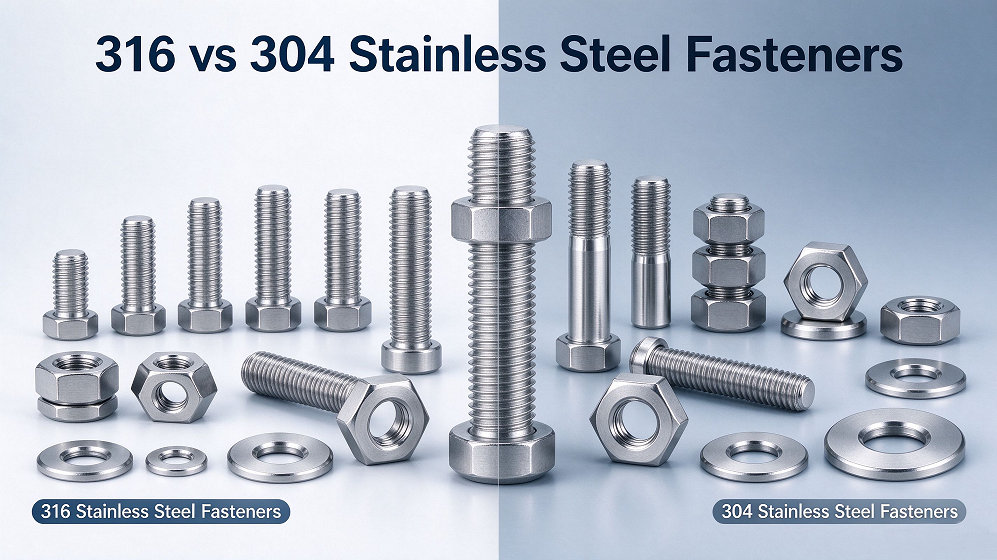
If you specify fasteners for coastal facilities, chemical processing plants, or food-grade equipment, you have likely faced this decision: 304 or 316 stainless steel? The price difference is real—often 25% to 35% more for 316—and the temptation to default to the cheaper grade is understandable. But the choice between these two austenitic stainless steels is not about “better” or “worse.” It is about one specific environmental variable: chloride exposure.
Here is the short version: 304 and 316 have virtually identical mechanical strength. The only meaningful difference is corrosion resistance in chloride-bearing environments, and that difference comes from one alloying element—molybdenum.
Chemical Composition: What Actually Differs
Both grades are austenitic stainless steels built on an iron-chromium-nickel base. The headline numbers look similar: 304 contains roughly 18% chromium and 8% nickel, while 316 contains about 16% chromium and 10% nickel . If you stopped there, you might assume they perform alike.
The critical distinction is molybdenum. Type 316 contains approximately 2% molybdenum, an element absent from 304 . This addition is not a marginal tweak. Molybdenum directly enhances the alloy’s ability to resist localized corrosion—specifically pitting and crevice corrosion—in the presence of chloride ions.
A useful way to quantify this is the Pitting Resistance Equivalent Number (PREN), calculated as %Cr + 3.3 × %Mo + 16 × %N. Type 316 typically achieves a PREN of around 25, roughly 4 to 5 points higher than Type 304 . That gap translates into a meaningful difference in service life wherever chlorides are present.
Corrosion Resistance: Where 316 Wins (and Where It Doesn’t Matter)
The scientific literature is clear on this point. In chloride solutions, 316 exhibits a more noble pitting potential than 304, meaning it resists the onset of pitting corrosion at higher electrochemical potentials . The molybdenum addition specifically increases resistance to pitting in chloride environments, though notably it has no such effect in bromide solutions . For industrial fasteners, chlorides are the relevant concern—and here, 316 outperforms.
Where 316 is the right call:
- Marine and coastal installations, including offshore platforms and dockside equipment
- Chemical processing involving chloride-containing media, such as brine, seawater cooling, or produced water
- Desalination plants and wastewater treatment facilities where salt exposure is continuous
- Any application where fasteners will be exposed to de-icing salts or salt spray
Where 304 is sufficient:
- General indoor industrial environments with no chloride source
- Food and beverage production in non-chlorinated areas (304 is FDA-compliant for food contact)
- Architectural and structural applications in mild, inland atmospheres
- Dry process equipment where moisture and salts are absent
A critical caveat: neither grade is suitable for aggressive high-temperature or high-concentration chloride service. If your application involves hot concentrated brine or strong acids, you may need to step beyond the 304/316 decision entirely, toward higher-alloy grades such as 904L or duplex stainless steels.
Strength and Mechanical Properties: Effectively Identical
Engineers occasionally assume that 316, being the “premium” grade, must also be stronger. It is not. Under ASTM A193, the specification covering alloy and stainless steel bolting for high-temperature service, Grade B8 (304) and Grade B8M (316) share identical mechanical requirements for Class 1 fasteners: minimum tensile strength of 75 ksi and minimum yield strength of 30 ksi . The chemistry differs, but the strength does not.
This matters for specification decisions. If your joint design requires a certain load-carrying capacity, upgrading from 304 to 316 will not change it. To increase strength within either grade, you would move to Class 2 (strain-hardened) material, which raises yield strength substantially—but that is a separate decision from the 304-versus-316 question .
Strength is not a valid reason to choose 316 over 304. Corrosion resistance is.
Cost Premium: When Is 316 Worth It?
The molybdenum content makes 316 more expensive. Across standard fastener forms, the premium over 304 typically runs in the range of 25% to 35%, though it can reach 40% for larger or cold-worked items and narrow for high-volume standard parts . Chinese wire rod pricing data confirms the same order of magnitude: 316L material costs roughly 20% to 30% more than 304 .
The correct way to evaluate this premium is through total cost of ownership, not first cost. If a 304 fastener fails prematurely in a coastal application, the replacement cost includes not just the part itself but labor, access equipment, and production downtime. One analysis framed the math bluntly: a 30% first-cost saving on 304 can become a 340% net loss after a single replacement cycle in a marine environment . Conversely, in a dry indoor plant where chlorides are simply absent, paying for 316 is wasted money—304 will outlast the equipment it fastens.
Quick Selection Checklist
Use these three questions to make the call:
1. Will the fastener see salt spray, seawater, or de-icing salts?
If yes → Specify 316. No exceptions.
2. Will it contact chloride-containing process media (brine, HCl vapors, chlorinated water)?
If yes → Specify 316, and verify the concentration and temperature against supplier corrosion data.
3. Is the environment dry, indoor, or otherwise chloride-free?
If yes → Specify 304. It will perform as required at lower cost.
If you are uncertain about the service environment, the responsible move is not to guess. Provide your supplier with the actual exposure conditions—chloride concentration, temperature, moisture presence—and request a material confirmation. The cost of a short technical review is trivial compared to the cost of a corrosion failure in the field.
The Bottom Line
The 304 versus 316 decision reduces to a single question: are chlorides present? If they are, 316’s molybdenum content is not an upgrade—it is a requirement. If they are not, 304 is the correct engineering choice, not a compromise. Strength is identical between the two grades; only corrosion resistance in chloride environments differs. Specify accordingly, and neither grade will surprise you.