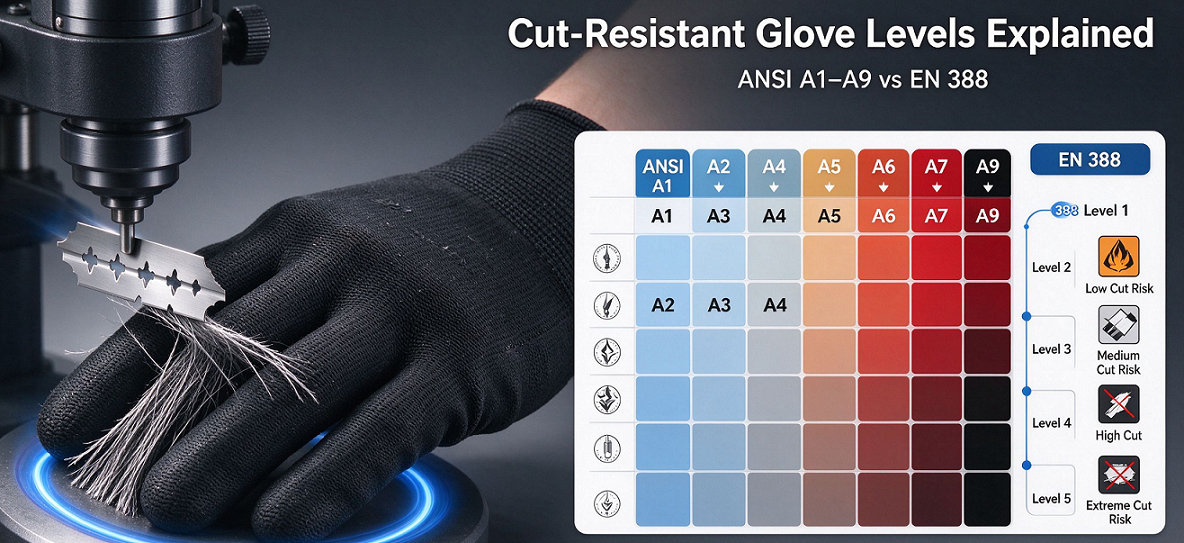
A procurement spec sheet lists “EN 388 Level D.” A worker’s task involves handling sheet metal with burred edges. Someone in the meeting asks whether that is the same as “ANSI A4.” The supplier says yes. The supplier is wrong.
ANSI A1–A9 and EN 388 cut ratings are both legitimate, well-defined standards. They use the same underlying testing machine and methodology. But they report results in different units, use different scales, and are not directly convertible without a test report to back the claim . Treating a letter grade and a number grade as interchangeable is one of the most common—and most dangerous—errors in glove specification.
This article explains what each standard actually measures, why the scales cannot be mapped onto each other, and how to select the right cut level for a specific task.
What ANSI A1–A9 Actually Measures
The ANSI/ISEA 105 standard, in its current 2024 revision, uses a nine-level scale from A1 to A9 . The rating is derived from the ASTM F2992 test method, performed on a TDM-100 machine. A straight blade is drawn across the glove sample under increasing force until cut-through occurs. The result is recorded in grams of force required to cut the material .
The levels break down as follows :
| ANSI Level | Cut Resistance (grams) | Typical Application |
|---|---|---|
| A1 | 200–499 | Packaging, light assembly, warehouse |
| A2 | 500–999 | General handling, light automotive |
| A3 | 1,000–1,499 | Automotive shops, small parts with rough edges |
| A4 | 1,500–2,199 | Construction, glass handling, metal sheet |
| A5 | 2,200–2,999 | HVAC, electrical work, metal fabrication |
| A6 | 3,000–3,999 | Sharp metals, some food processing |
| A7 | 4,000–4,999 | Metal stamping, recycling sorting |
| A8 | 5,000–5,999 | Heavy-duty sharp steel, glass manufacturing |
| A9 | 6,000+ | Extreme-risk industrial cutting |
The practical grouping is straightforward: A1–A3 for low-risk handling with high dexterity needs; A4–A6 for moderate to high cut risk where a balance of protection and feel is required; A7–A9 for applications where the edge is genuinely dangerous and dexterity is secondary .
What EN 388 Actually Measures (and Why There Are Two Cut Ratings)
EN 388 is the European standard for mechanical risks. The 2016 revision introduced a significant change that remains a source of confusion: the pictogram now contains two separate cut ratings in different positions.
Position “b” (the Coup test) uses a rotating circular blade under a fixed load. It reports a score from 0 to 5. This was the original EN 388 cut test. Its limitation is that the blade dulls during testing of high-performance materials, producing unreliable results for gloves made with HPPE, steel filament, or fiberglass .
Position “e” (the ISO 13997/TDM test) uses the same straight-blade methodology as the ANSI test. It reports a letter grade from A to F, measured in Newtons of force. This is the rating that matters for modern high-cut-resistant gloves .
The EN ISO cut levels (position “e”) are :
| EN Level | Force (Newtons) |
|---|---|
| A | 2 |
| B | 5 |
| C | 10 |
| D | 15 |
| E | 22 |
| F | 30 |
When a glove has an “X” in position “b” of its EN 388 pictogram, it means the Coup test was not applicable or not performed—typically because the material caused blade dulling. In that case, only the ISO 13997 letter grade (position “e”) is meaningful .
Why You Cannot Convert A4 to Level D
The ANSI A-levels and the EN ISO letter grades use the same machine and the same straight-blade cutting action. The difference is the unit of measurement. ANSI reports grams; EN ISO reports Newtons. One Newton is approximately 102 grams-force. A Level D glove, rated at 15 Newtons, corresponds to roughly 1,530 grams—which falls within the ANSI A4 band of 1,500–2,199 grams .
So A4 and D are approximately equivalent in force. But “approximately” is the operative word, and it is not good enough for a formal specification.
The standards bodies and glove manufacturers are explicit on this point. A glove that achieves EN Level C (10 Newtons) cannot claim ANSI A3 (1,000–1,499 grams) without separate testing to the ANSI standard . The test methods, sample preparation, and reporting requirements differ in ways that make direct conversion unsupported. A marketing comparison chart may help create a shortlist, but only the declared test result on the actual glove model and size range can support a procurement decision .
The practical rule: Read the rating that is printed on the glove you are buying. If the spec requires ANSI A4, the glove needs an ANSI A4 test report. If the spec requires EN Level D, it needs an EN Level D test report. Do not accept a supplier’s verbal assurance that one “equals” the other.
Selection Logic: Match the Level to the Edge, Not the Catalog
The most common selection error is not choosing the wrong number. It is choosing a number without first describing the task.
Step 1: Describe the actual cut hazard. “Metal handling” is too vague to select a level. Is the worker lifting finished panels with deburred edges? Removing sharp offcuts from a press? Changing a slitter blade? Each involves a different edge geometry, force, and exposure duration .
Step 2: Determine whether higher-level controls are in place. Guards, jigs, deburring, and handling tools reduce the cut risk before PPE is considered. A glove is the last line of defense, not the first .
Step 3: Select a starting level based on the edge. For packaging and general warehouse work with no sharp edges, A1–A2 is appropriate. For sheet metal with burrs, A4 or above is the starting point. For blade contact or heavy sharp steel, A7–A9 territory begins .
Step 4: Balance against dexterity and other hazards. A9 gloves offer extreme cut resistance, but the bulk and stiffness may make them unsuitable for tasks requiring finger control. They may also increase heat retention or reduce grip. The goal is the lowest level that controls the assessed risk while allowing the worker to do the job safely .
Step 5: Verify with a wearer trial. Give the shortlisted gloves to trained workers and observe grip, fit, sweating, and compatibility with tools. A glove that passes the lab test but fails in the hand is not a solution .
A Procurement Checklist for Cut-Resistant Gloves
Before approving a glove specification, confirm:
- The risk assessment names the specific sharp object and cutting action, not just “cut hazard.”
- The standard edition is correct: ANSI/ISEA 105-2024 where specified .
- The A1–A9 or EN letter grade applies to the exact glove model and size range being purchased.
- The supplier provides a test report or conformity documentation for that model.
- If both ratings appear on the glove, they were tested separately—not converted by the supplier.
- An “X” in the EN 388 pictogram is understood as “not tested” for that position, not as a pass .
- The glove also meets abrasion, puncture, and grip requirements for the task.
- Workers have trialed the glove and can perform the task with adequate dexterity.
The Bottom Line
ANSI A1–A9 and EN 388 letter grades measure the same physical property with the same type of machine, but they report in different units and cannot be formally converted. A4 and Level D are close in force, but close is not a specification. Specify the rating the standard actually requires, demand the test report for the exact glove, and select the lowest level that controls the assessed hazard without compromising the worker’s ability to do the job.