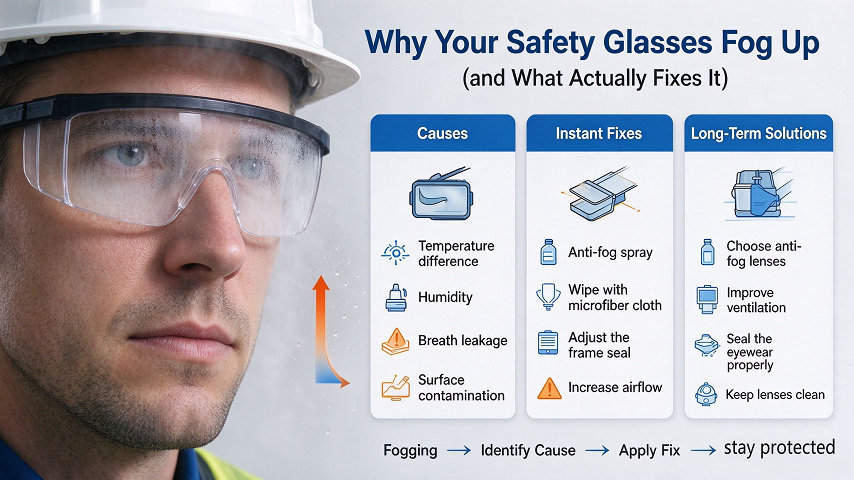
A worker takes off their safety glasses mid-task because they cannot see through the fog. The safety manager sees a compliance problem. The procurement team sees a product that “doesn’t work.” Both are looking at the wrong thing.
Fogging is not a failure of the lens. It is condensation—water vapor from the wearer’s breath or sweat condensing on a surface that is cooler than the surrounding air. The physics is the same as a cold drink glass sweating on a summer day. The fix is not a “better” lens in the abstract. It is managing the temperature differential, the humidity source, or the surface property of the lens itself.
Most fogging solutions sold to industrial buyers address only one of these three variables. That is why a worker can try three different anti-fog sprays and still end up with obscured vision by mid-shift.
The Three Variables That Cause Fogging
Condensation forms when moist air contacts a surface below the dew point. In the context of safety eyewear, three factors interact:
Temperature differential. The lens is cooler than the air trapped between the lens and the face. In cold environments, the lens chills quickly when the worker steps outside or enters a refrigerated area. Indoors, the differential comes from the face itself: the skin and breath are warm, the lens is at ambient room temperature.
Humidity source. The primary source is exhaled breath, particularly when a respirator or face mask is worn and the exhaled air is directed upward toward the eyes. Sweat is a secondary source, especially in hot work or under hard hats with limited airflow.
Surface energy of the lens. A standard polycarbonate lens is hydrophobic—water vapor does not spread evenly across it. Instead, droplets nucleate and grow into the visible mist that scatters light. A hydrophilic surface changes this behavior by allowing water to spread into a thin, transparent film rather than discrete droplets .
Understanding which variable dominates in a specific application determines which fix is worth the money.
What Actually Works (Ranked by Effectiveness)
1. Interrupt the Breath Path
If the worker wears a face mask or respirator, the single most effective intervention is preventing exhaled air from reaching the lens. A mask with a moldable nose bridge, properly pinched to the face, redirects breath downward and away from the eyes . This costs nothing beyond selecting the right mask and training the worker to fit it correctly.
For workers in dusty or splash environments who need a sealed goggle rather than spectacles, an indirect-vented design allows air exchange while blocking liquid ingress. The ventilation path reduces humidity buildup inside the goggle without creating a splash pathway .
2. Use a Genuine Anti-Fog Coating, Not a Spray
The permanent anti-fog coatings applied by reputable manufacturers are not the same product as aftermarket sprays and wipes. Factory coatings are typically hydrophilic polymers bonded to the lens surface, designed to survive repeated cleaning. 3M’s Scotchgard anti-fog coating, for example, is rated to retain effectiveness for at least 25 washings .
Aftermarket sprays and wipes work on the same principle—depositing a surfactant or hydrophilic layer—but the layer is temporary and easily compromised by cleaning or handling. They are a reasonable stopgap, not a solution. A field review of one goggle product noted that even with anti-fog spray applied, the lenses fogged within two minutes when worn over prescription glasses with a mask . The spray was not the problem; the breath path was.
A practical caution: some manufacturers now offer premium permanent coatings (platinum-cured, for example) that perform exceptionally well in laboratory demonstrations. These are legitimate, but they come at a higher cost and require water-based cleaning only—alcohol or solvent cleaners will degrade the coating . For most industrial applications, a standard factory anti-fog coating from a reputable brand is sufficient.
3. Manage the Temperature Differential
In cold environments, warming the lens before donning it reduces the initial condensation burst. Keeping eyewear in an inside pocket rather than a cold locker or vehicle cab makes a measurable difference in the first few minutes of use . This is a low-cost habit change, not a product purchase.
In hot environments, the differential is less about ambient temperature and more about trapped humidity. A frame with better airflow around the eyes—a wrap style with vented temples, or a goggle with indirect vents—allows the humid air to escape rather than condensing on the lens.
4. The Soap Trick: Effective but Temporary
A thin film of mild dish soap, applied and buffed dry, leaves a surfactant layer that spreads condensation into a transparent sheet rather than droplets. This is a legitimate field expedient and costs essentially nothing . The limitation is durability: the film washes away with sweat, rain, or cleaning, and reapplication is needed frequently. It is useful for a short task or as an emergency measure, not a shift-long solution.
What Does Not Work (Despite Being Sold)
“Anti-fog” claims on low-cost goggles. A product listing that says “anti-fog” is not a guarantee. Customer reviews of budget safety goggles frequently report fogging within minutes of use, even when the product description claims anti-fog performance . The lesson is not that all anti-fog products are fraudulent, but that the claim requires verification through specification or reputation, not marketing copy.
Tighter fit. A common instinct when glasses fog is to tighten them against the face. This usually makes the problem worse by reducing airflow and trapping more humid air against the lens.
More frequent wiping. Wiping removes the immediate fog but also removes any anti-fog coating or surfactant film that was present. Over a shift, the worker progressively destroys the very treatment meant to help them. A microfiber cloth and mild soap cleaning is appropriate; a sleeve or paper towel is not.
A Decision Sequence for the Safety Manager
When a worker reports fogging, work through this sequence before purchasing anything:
Step 1: Is a mask or respirator involved? If yes, fix the mask fit first. A moldable nose bridge, properly shaped, solves more fogging complaints than any lens product. Verify the worker knows how to fit it, not just that they were issued one.
Step 2: What is the environment? Cold storage or outdoor winter work calls for warming the lens and selecting a frame with better peripheral airflow. Hot, humid indoor work calls for vented frames and a factory anti-fog coating.
Step 3: Is the current eyewear coated, or bare polycarbonate? If the answer is unclear, it is probably bare. Specify factory anti-fog coating on the next order. The cost premium is modest and the compliance improvement is measurable.
Step 4: Is the coating being destroyed by cleaning? Check what the workers are using to clean their lenses. Alcohol wipes, solvent-based cleaners, and abrasive paper towels will strip or damage most anti-fog coatings. Provide mild soap, water, and microfiber cloths at cleaning stations .
The Bottom Line
Safety glasses fog because of a temperature differential and a humidity source, not because the lens is defective. The most effective fix is usually not a product at all—it is interrupting the path of exhaled breath with a properly fitted mask. When a product fix is needed, a factory-applied anti-fog coating on a vented frame outperforms aftermarket sprays over the course of a shift. The soap trick is a legitimate emergency measure, not a strategy. And no coating will survive a worker wiping their lenses with a solvent-soaked rag or a gritty paper towel.
The compliance problem the safety manager sees is real. But the solution starts one step upstream of the eyewear catalog—at the mask fit and the cleaning station.