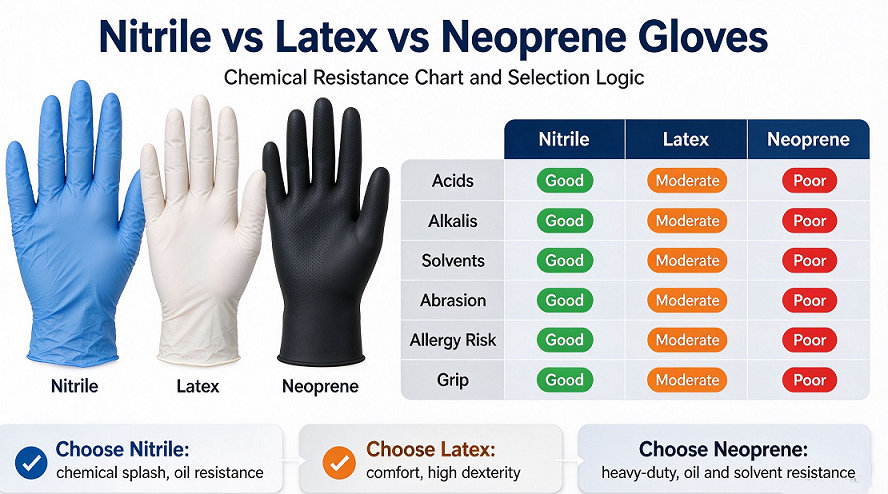
Most glove selection decisions in a plant are made from a shelf, not a spec sheet. Someone grabs what is available, checks that it fits, and moves on. The result is predictable: a glove that feels protective but allows a solvent to pass through at the molecular level without any visible sign of failure. OSHA’s guidance is blunt on this point—improper selection can give workers a false sense of security because chemicals may penetrate the “protection” without it showing any signs of failure .
The three materials most commonly stocked in industrial settings—nitrile, latex, and neoprene—have genuinely different chemical resistance profiles. Choosing between them is not a matter of “which is best.” It is a matter of matching the material to the specific chemical, the exposure duration, and the physical demands of the task.
The Only Metric That Matters: Breakthrough Time
Before comparing materials, you need to understand what “chemical resistance” actually means in a standard.
Chemical resistance is not a binary property. A glove material does not “resist” or “fail to resist” a chemical. It delays permeation—the molecular-level passage of a chemical through the glove material—for a measurable period. That period is the breakthrough time, defined as the time from initial contact on the outside surface to detection on the inside surface .
EN ISO 374-1 assigns performance levels based on breakthrough time:
| Performance Level | Breakthrough Time |
|---|---|
| Level 1 | > 10 minutes |
| Level 2 | > 30 minutes |
| Level 3 | > 60 minutes |
| Level 4 | > 120 minutes |
| Level 5 | > 240 minutes |
| Level 6 | > 480 minutes |
A glove rated Level 6 against acetone offers more than 480 minutes of protection. A glove rated Level 1 against the same chemical offers just over 10 minutes. Both may be labeled “chemical resistant.” Only one is appropriate for a task that lasts an hour.
The critical caveat: these times are measured under laboratory conditions at controlled temperature, using pure chemicals and samples taken from the glove palm only . In the field, temperature, mechanical flexing, abrasion, and chemical mixtures all reduce actual protection time. A glove that achieves Level 3 in the lab may breach in half that time on a hot workstation with a solvent mixture.
Material-by-Material: What Each Does Well
Nitrile (NBR)
Nitrile is the default choice for most industrial chemical handling, and for good reason. It performs well against oils, greases, acids, caustics, and alcohols . For maintenance tasks involving lubricants, hydraulic fluid, and general-purpose cleaning chemicals, nitrile is usually the correct starting point.
Where nitrile fails: aromatic solvents (toluene, xylene, benzene) and oxidizing agents. It is also unsuitable for ketones and strong solvents. A field ranking of glove materials against petroleum and coal-derived liquids placed nitrile in the mid-to-upper tier—better than latex and neoprene, but below specialized materials like Viton and PVA . Nitrile is not a universal glove, and treating it as one is a common error.
Latex (Natural Rubber)
Latex has a narrow but legitimate role. It performs adequately against aqueous solutions of acids, alkalis, salts, and ketones . For tasks involving water-based cleaning chemicals at mild concentrations, latex can work.
Where latex fails: the evidence against latex is stronger than its remaining use cases justify in most industrial settings. A 2018 study assessing disposable gloves for handling cleaning chemicals found latex gloves to be “the least suitable” of the materials tested, with breakthrough times as low as a few seconds for some products . The same study noted that latex gloves were often not CE-marked for chemical protection at all. A field test of latex gloves against metalworking fluid found permeation within 20 minutes of exposure, exceeding the threshold for breakthrough under ASTM F739 .
Latex also carries the allergen risk. For any workplace with multiple employees, the sensitization and allergy potential of natural rubber latex is a liability that nitrile does not carry.
Neoprene (Polychloroprene)
Neoprene occupies a middle ground that is often misunderstood. It is suitable for hydraulic fluids, alcohols, organic acids, and alkalis . Against hydrocarbon fuels, a general ranking placed neoprene above latex but below nitrile .
Where neoprene has an edge: neoprene’s real advantage is not chemical resistance in the abstract. It is durability and physical toughness. Neoprene gloves tend to resist abrasion and tearing better than thin nitrile or latex disposables. For tasks that combine moderate chemical exposure with mechanical stress—handling oily parts with sharp edges, for example—neoprene may outlast a nitrile glove that would offer comparable permeation resistance.
Where neoprene fails: it is not a barrier against aromatic solvents or chlorinated hydrocarbons. It should not be specified for paint stripping, degreasing with toluene or xylene, or any task involving strong solvents.
The Selection Framework
Rather than asking “which glove is best,” work through three questions in order.
Question 1: What is the primary chemical?
Check the Safety Data Sheet. Section 8 lists the glove materials recommended by the chemical supplier. This is the starting point, not the final answer—SDS recommendations are often conservative and material-generic. But if the SDS says “butyl rubber” and you are considering nitrile, you need a specific reason to override it.
If the chemical is a solvent, look at the class. Aromatic hydrocarbons (toluene, xylene) and chlorinated solvents (dichloromethane, trichloroethylene) defeat nitrile, latex, and neoprene alike. These require butyl, Viton, or PVA—not a thicker version of the same disposable.
Question 2: How long is the actual exposure?
A task that involves dipping a part into a cleaning bath for thirty seconds is different from a task where the glove is saturated for two hours. Match the EN ISO 374 performance level to the exposure duration, then apply a safety factor. If the task lasts 30 minutes and the glove is rated Level 2 (>30 minutes), that is insufficient margin. A Level 3 or 4 rating provides more realistic protection once field conditions are accounted for.
Question 3: What else is the glove doing?
Chemical resistance is one property among several. A glove that offers Level 4 permeation resistance but tears on the first sharp edge is not protecting the worker. Consider:
- Abrasion resistance: neoprene generally outperforms thin nitrile and latex
- Dexterity: thin nitrile disposables offer the best tactile feedback; heavier neoprene reduces it
- Grip in oily conditions: nitrile’s oil resistance translates into maintained grip; latex becomes slick
- Allergen risk: latex is the only material of the three with significant sensitization potential
A Working Chart for Common Industrial Chemicals
The following summarizes general suitability. It is not a substitute for manufacturer-specific permeation data, which varies by glove thickness, formulation, and test conditions.
| Chemical Class | Nitrile | Latex | Neoprene |
|---|---|---|---|
| Oils, greases, hydraulic fluid | Good | Poor | Good |
| Alcohols (methanol, ethanol) | Good | Fair | Good |
| Dilute acids and caustics | Good | Fair | Good |
| Aromatic solvents (toluene, xylene) | Poor | Poor | Poor |
| Chlorinated solvents | Poor | Poor | Poor |
| Ketones (acetone, MEK) | Fair/Poor | Fair | Fair/Poor |
| Aqueous cleaning solutions | Good | Fair | Good |
Reading the chart: “Poor” means the material is not appropriate for sustained contact. “Fair” means it may be acceptable for short exposures with close supervision, but is not the first choice. “Good” means the material is a reasonable default, subject to breakthrough-time verification for the specific product and task duration.
For any chemical not listed, or any mixture, do not extrapolate. Mixtures behave differently from their individual components, and the dominant solvent in a mixture often determines the permeation rate of the others . Request manufacturer permeation data for the actual formulation, or use a glove testing service.
The Bottom Line
Nitrile is the correct default for most industrial maintenance and chemical handling tasks. It handles oils, greases, dilute acids, and alcohols well, and it avoids the allergen liability of latex. Latex is rarely the best choice in an industrial setting and should be phased out where nitrile can substitute. Neoprene earns its place where mechanical durability matters alongside moderate chemical exposure.
The selection error that causes the most harm is not choosing the “wrong” material in the abstract. It is choosing a glove that is labeled “chemical resistant” without checking the breakthrough time against the actual task duration. A Level 1 glove used for a two-hour task is not protection. It is a countdown timer that the worker cannot see.