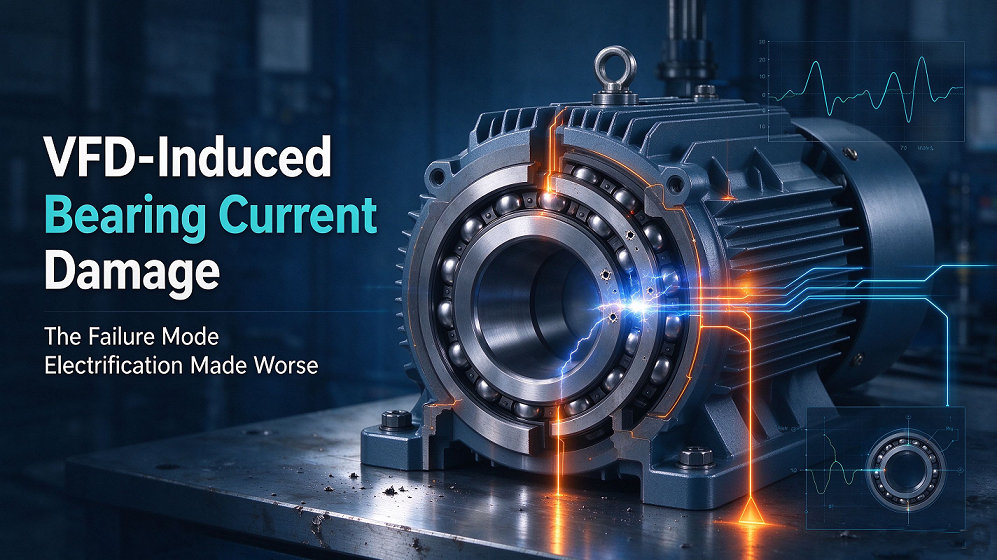
If you have replaced a motor bearing in the last three years and the old one came out with a washboard pattern on the raceway, you are not imagining a new failure mode. You are looking at the most predictable consequence of running a motor on a variable-frequency drive.
The mechanism is not mysterious, but it is frequently misdiagnosed as “normal wear” or blamed on lubrication. By the time the fluting is visible, the bearing has already been through millions of discharge cycles. The fix is not a better grease. It is interrupting the current path.
What the Raceway Is Telling You
The visual signature of electrical erosion is distinctive enough to diagnose on the bench. Early damage appears as localized micro-pits: small, darkened craters where the arc flash melted and re-hardened the steel surface . As discharge continues, these pits align into transverse ridges across the raceway—the “washboard” or fluting pattern that gives the failure its name .
The damage is not cosmetic. Each micro-pit acts as a stress concentration. The hardened, brittle crater edges initiate fatigue cracks under normal rolling contact. A bearing operating under sustained electrical discharge can fail in as little as 10–20% of its calculated L10 life . The lubricant is a secondary casualty: repeated arcing carbonizes the grease, which then loses film strength and accelerates mechanical wear on top of the electrical damage .
Why VFDs Make This Worse
A motor on a sinusoidal mains supply has a relatively benign shaft voltage profile. A VFD is different. The pulse-width modulation switching creates high-frequency common-mode voltage on the rotor shaft. When that accumulated potential exceeds the dielectric breakdown threshold of the lubricant film—typically a few microns thick in a grease-lubricated bearing—the current discharges across the rolling contact .
The physics has not changed since the 1920s, when fluting was first observed . What has changed is the installed base. Electrification of industrial drives, HVAC systems, and material handling equipment has put VFDs on motors that previously ran across-the-line. The failure mode that was once a niche concern in large drives is now a routine risk in standard induction motors.
Field Diagnosis: Three Checks Before You Pull the Bearing
Check 1: The raceway pattern. Fluting is diagnostic. If the damage is uniform across the loaded zone and shows periodic ridges matching the ball or roller spacing, current passage is the root cause. If the damage is localized to one side, look for misalignment first.
Check 2: The grease condition. Electrically degraded grease often appears darkened or carbonized near the rolling contact, with a burnt odor. This distinguishes current damage from simple starvation, where the grease may be intact but insufficient in quantity .
Check 3: The drive architecture. Is the motor fed by a VFD? Is the cable run long? Is the motor frame grounded on both ends? A floating or poorly grounded system raises shaft voltage and increases discharge frequency.
The Fix Is a Circuit Problem, Not a Bearing Problem
No bearing material or grease specification will survive sustained electrical discharge. The solution is to break the current path.
Option 1: Insulated bearings. A ceramic or oxide coating on the outer ring (or inner ring, depending on the application) blocks the discharge path through the rolling elements. This is the most common retrofit for motors under 100 kW.
Option 2: Shaft grounding. A carbon brush or conductive fiber ring maintains a low-resistance path from shaft to housing, bleeding off the accumulated voltage before it reaches the breakdown threshold. This is often specified alongside insulated bearings in larger drives.
Option 3: Common-mode filtering. Where the drive is the dominant source, a common-mode choke or filter on the output side reduces the high-frequency voltage that reaches the motor. This addresses the source rather than the symptom.
The engineering judgment is straightforward: if the application uses a VFD and the bearing failure shows fluting, replace the bearing with an insulated variant and verify the grounding path. Replacing with a standard bearing and a “premium” grease will produce the same failure again.