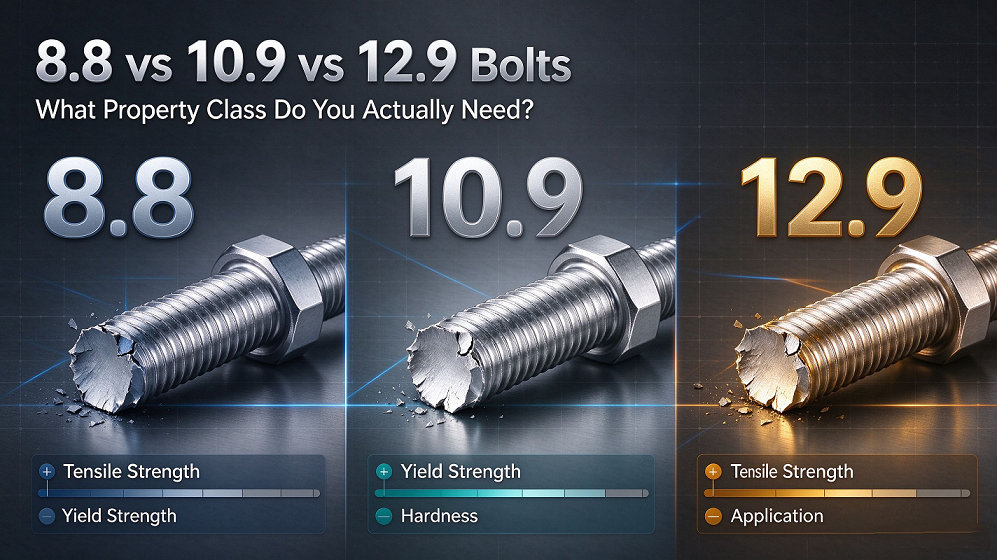
A common scene in procurement and engineering offices: a drawing specifies “Property Class 10.9,” and someone asks whether 8.8 will do instead. Or the reverse—a buyer wonders if upgrading to 12.9 is the safer choice. Both questions miss the point. Property class is not a ladder where higher is always better. It is a design decision driven by the joint’s preload requirement, the fastener’s exposure to hydrogen, and the consequences of over-engineering.
Here is the short version: 8.8, 10.9, and 12.9 differ in tensile strength, but the real decision hinges on hydrogen embrittlement risk and whether the joint actually needs the added preload. Choosing the highest class available is not good engineering—it is a gamble with delayed fracture.
What the Numbers Actually Mean
ISO 898-1 defines the property class system for metric steel bolts, screws, and studs. The two digits are not arbitrary labels. They encode the material’s minimum tensile strength and yield ratio.
For Class 8.8, the nominal tensile strength is 800 MPa, with a minimum yield strength (0.2% proof stress) of 640 MPa. Class 10.9 raises nominal tensile strength to 1000 MPa and minimum yield to 900 MPa. Class 12.9 reaches 1200 MPa nominal tensile strength with a minimum yield of 1080 MPa . These are minimum values—actual test results will vary within the specification’s tolerances.
The practical implication is straightforward: a 12.9 bolt can carry roughly 50% more load than an 8.8 bolt of the same diameter before yielding. That difference matters in joints where space is constrained and you cannot simply use a larger fastener. It does not matter in joints where the design is already governed by the clamped members, not the bolt.
When 8.8 Is the Right Choice
For the majority of general mechanical connections, 8.8 is sufficient. Structural steelwork under AS/NZS 1252 routinely specifies Property Class 8.8 for high-strength structural bolts in non-critical applications . General machinery assembly, brackets, guards, and most indoor equipment fall well within 8.8’s capacity.
The more important reason to specify 8.8 is hydrogen embrittlement resistance. Higher-strength steels are more susceptible to hydrogen-induced delayed fracture. Class 8.8, with its lower strength level, carries substantially less risk when the fastener undergoes acid pickling, electroplating, or cathodic cleaning—processes that can introduce atomic hydrogen into the steel. If the fastener will be electroplated zinc, 8.8 is the prudent default unless the design absolutely requires higher strength and the plater can demonstrate proper baking and quality control.
When You Need 10.9 or 12.9
Class 10.9 and 12.9 enter the picture when the joint requires high preload and the bolt diameter is fixed by envelope constraints. Engine connecting rods, cylinder head bolts, high-pressure flange joints, and die-casting mold clamps are typical examples. In these applications, the bolt must generate enough clamping force to keep the joint closed under operating loads, and a larger bolt will not fit.
Class 12.9 goes a step further. Its yield strength of 1080 MPa minimum means it can sustain preloads that would permanently deform a 10.9 bolt. But that additional capacity comes with a documented trade-off: research comparing 12.9 42CrMo steel against 10.9 20MnTiB steel found that the 12.9 grade exhibits inferior resistance to hydrogen-induced delayed fracture. The study concluded that simply extending existing design codes to cover 12.9 connections is not safe without accounting for this reduced resistance . In other words, 12.9 is not merely “stronger 10.9.” It behaves differently under hydrogen exposure, and the consequences of getting it wrong are delayed failures that can occur hours or days after assembly.
Hydrogen Embrittlement: The Hidden Risk of High Property Classes
The mechanism is well understood. High-strength steels—generally those with tensile strength above 1000 MPa—absorb atomic hydrogen during acid pickling, electroplating, or cathodic cleaning. That hydrogen diffuses into the steel and accumulates at stress concentrations. Under sustained load, it can cause a crack to initiate and propagate, leading to brittle fracture at stress levels far below the material’s yield strength .
The risk scales with strength. Class 10.9 and 12.9 fasteners are squarely in the danger zone. Indian Standard IS 1367 Part 13, which addresses hot-dip galvanizing of threaded fasteners, explicitly requires that bolts of Property Class 10.9 or higher be baked at 200°C for at least 30 minutes to diffuse hydrogen before or after galvanizing . This is not a suggestion—it is a process requirement, and it adds cost and lead time.
For the buyer, the practical action is to specify the coating and the de-embrittlement requirement together. If a supplier quotes 10.9 or 12.9 bolts with electroplated zinc and cannot produce baking records, the risk is yours. A safer path in corrosive environments is to specify a non-electrolytic coating—zinc flake, Dacromet, or Geomet—which avoids the hydrogen introduction step entirely.
Selection Flow: Three Questions
Rather than defaulting to a class number, work through the joint requirement.
First: What preload does the joint need? Calculate the clamping force required to keep the joint closed under operating loads. If an 8.8 bolt of the available diameter can generate that force with an adequate safety margin, stop there. There is no engineering justification for going higher.
Second: What is the coating process? If electroplating is specified, 8.8 is preferred. If 10.9 or 12.9 is mandatory for strength reasons, require documented baking and consider a non-electrolytic coating instead.
Third: What are the consequences of a delayed fracture? For a guardrail bracket, an 8.8 failure might be an inconvenience. For a cylinder head bolt on a running engine, a 12.9 failure can be catastrophic. The higher the consequence, the more rigorous the hydrogen controls must be—and the more carefully you should question whether the higher class is truly necessary.
The governing principle is simple: specify the lowest property class that satisfies the design load, not the highest class the budget allows. Strength is cheap to add and expensive to control. Hydrogen embrittlement is the price of forgetting that.